

Traveling with a child for the holidays: notice, itineraries and out-of-state consent in North Carolina
A Thanksgiving or winter-break trip out of North Carolina is governed first by your custody order or signed agreement, not by a single statewide “permission form.” G.S. 50-13.2(c) allows a custody order to provide for a child to be taken outside the State and, if the order contemplates a return, to require a bond or other security for that return. Many Huntersville orders also require written notice, an itinerary and a way to reach the traveling parent. The Uniform Child-Custody Jurisdiction and Enforcement Act, in G.S. 50A-201, uses a six-month “home state” rule for initial custody jurisdiction. Read the paperwork you already have before you buy tickets.


Read the order before you book the trip
Holiday travel disputes usually start with a booked flight and an order nobody reread. Before you reserve anything, pull the current custody order, any later consent order, and any separation agreement parenting terms that still apply. Look for:
- Whether out-of-state or overnight travel is allowed, limited, or conditioned on consent.
- How many days of written notice you must give, and to whom.
- Whether you must provide an itinerary, flight numbers, lodging address and a reachable phone number.
- A bond or other security under G.S. 50-13.2(c).
- Passport, real-ID or airline-document language, if any.
- Which parent’s holiday time includes the travel days, and how exchanges work at the airport or at a north Mecklenburg location.
If the order requires consent and you do not have it in writing, a ticket is not a workaround. If the order is silent, do not treat silence as a green light, especially for a trip that lasts more than a short visit or that could interfere with the other parent’s scheduled time. Our Mecklenburg custody guide covers the broader best-interest framework under G.S. 50-13.2.
What G.S. 50-13.2(c) actually says
The statute is short and specific. An order for custody “may provide for such child to be taken outside of the State,” and “if the order contemplates the return of the child to this State, the judge may require the person, agency, organization or institution having custody out of this State to give bond or other security conditioned upon the return of the child to this State in accordance with the order of the court.”
Three practical points follow from that language. First, authority to leave the State is something the order may provide; it is not a stand-alone statutory right to travel whenever you wish. Second, a bond is a tool the court may use when a return is contemplated; it is not required in every case. Third, the statute does not create a statewide, one-size notice period. Notice and itinerary rules are terms the court may include under G.S. 50-13.2(b), which requires the order to include the terms that best promote the child’s interest and welfare.
Relocation, meaning a lasting move, is a different problem from a holiday visit. See our guide to relocating with a child if the “visit” is actually a planned change of residence.
The UCCJEA and a stay that lasts too long
North Carolina has adopted the Uniform Child-Custody Jurisdiction and Enforcement Act in Chapter 50A. For an initial custody determination, G.S. 50A-201 generally looks to the child’s “home state”: the state where the child lived with a parent or a person acting as a parent for at least six consecutive months immediately before the case was filed (or since birth if the child is younger than six months). North Carolina can also act if it was the home state within that six-month period, the child is now absent, and a parent still lives here.
A week with grandparents in another state, followed by a return to Huntersville, does not by itself rewrite the home state. The risk rises when a visit becomes a stay: school enrollment, a new pediatrician, a delayed return, or a petition filed in the other state. If North Carolina has already entered a custody order, G.S. 50A-202 addresses exclusive, continuing jurisdiction. Temporary emergency jurisdiction, under G.S. 50A-204, is narrower: it applies when the child is present in this State and has been abandoned, or when an emergency order is necessary to protect the child, a sibling, or a parent from mistreatment or abuse. It is not a tool for winning a holiday argument.


Itineraries, exchanges and closed courthouses
When you do travel under an order that allows it, send the other parent a single written itinerary: dates, flight or driving route, lodging, and a phone number that will work. Exchange the child at the time and place the order names. If you need a one-time change because of a delayed flight, put the new time in writing and offer a specific makeup.
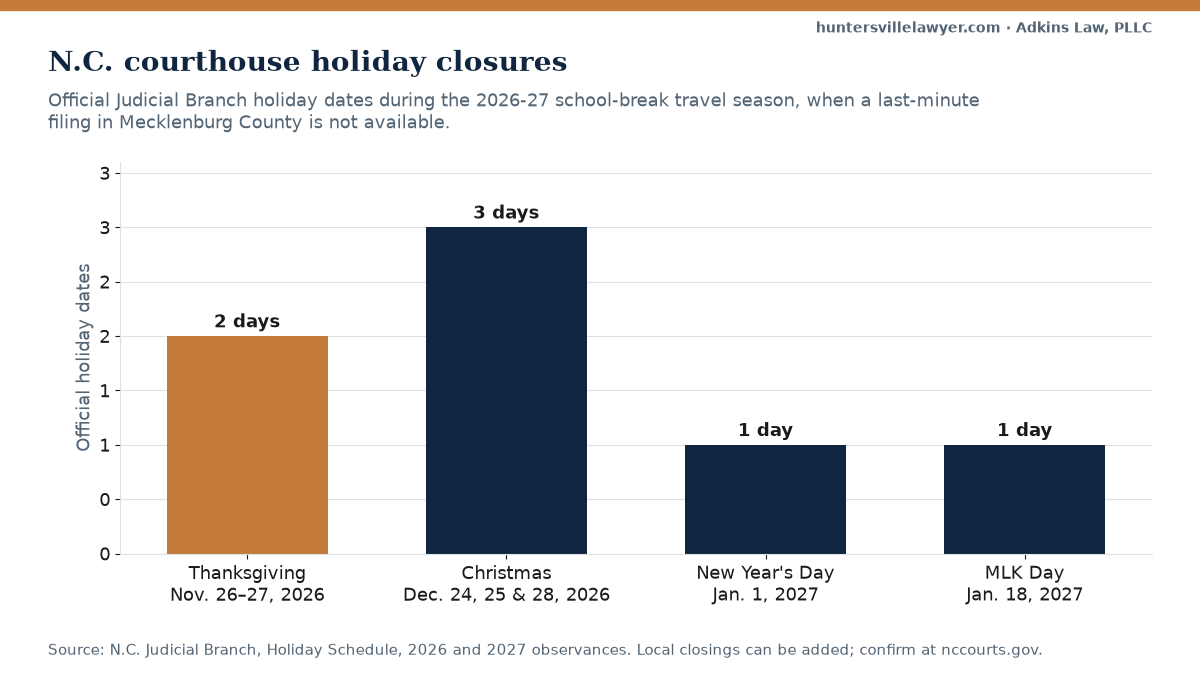
Do not plan to “sort it out at the courthouse” on Thanksgiving or Christmas. The North Carolina Judicial Branch holiday schedule lists these closures in the current travel season:
Source: N.C. Judicial Branch, Holiday Schedule. The Mecklenburg County Courthouse at 832 East Fourth Street, Charlotte, follows this schedule. Confirm later closings on the Judicial Branch site.
| Observance | Dates the Judicial Branch lists as holidays | Weekdays closed |
|---|---|---|
| Thanksgiving 2026 | Thursday, Nov. 26 and Friday, Nov. 27 | 2 |
| Christmas 2026 | Thursday, Dec. 24; Friday, Dec. 25; Monday, Dec. 28 | 3 |
| New Year’s Day 2027 | Friday, Jan. 1 | 1 |
| Martin Luther King Jr. Day 2027 | Monday, Jan. 18 | 1 |
The Clerk of Superior Court office in Mecklenburg County is open to the public 9:00 a.m. to 5:00 p.m., Monday through Friday, on ordinary business days. Passport applications, airline document rules and TSA identification rules are federal or carrier policies, not Chapter 50. Confirm those requirements with the responsible agency or airline before you travel; this article does not restate them, because they change and they sit outside North Carolina custody law.
When there is no order yet
Unmarried parents and parents who have just separated often have no court order at all. In that situation there is no clerk-stamped holiday schedule for a police officer to “enforce” at the airport. Either parent may later file a custody action under G.S. 50-13.1. Between the parents, G.S. 50-13.2(a) says that no presumption applies as to who will better promote the child’s welfare. A written, acknowledged agreement is far safer than a verbal “we’ll work it out.” Married parents can also use a separation agreement under G.S. 52-10.1, which must be in writing and acknowledged before a certifying officer. Tomorrow’s article in this series takes up Thanksgiving when there is no order.
Questions Huntersville parents ask
Do I automatically have the right to take my child out of state for Christmas?
Not automatically. Start with your order or signed agreement. G.S. 50-13.2(c) allows a custody order to provide for out-of-state travel and, if a return to North Carolina is contemplated, to require a bond or other security. Many orders also add notice, itinerary and consent terms. If the order is silent, do not assume consent.
Is there a statewide number of days of notice I have to give?
Chapter 50 does not set a single statewide notice period for holiday travel. The deadline, if there is one, is in your order or agreement. If you have no written rule, give as much written notice as you can and ask for written consent, but notice alone does not replace a required consent clause.
What is the UCCJEA “home state” rule?
Under G.S. 50A-201, North Carolina generally has jurisdiction to make an initial custody determination if it is the child’s home state on the date a case is filed, or was the home state within the previous six months and a parent still lives here. A long holiday visit in another state does not, by itself, instantly move the home state, but staying, enrolling school, or filing a case somewhere else can create a serious jurisdictional problem. Get advice before a trip that might become a stay.
The courthouse will be closed when we travel. What if something goes wrong?
The Judicial Branch lists Thanksgiving (November 26–27, 2026), Christmas (December 24, 25 and 28) and New Year’s Day (January 1, 2027) as holiday closures. The Mecklenburg County Courthouse follows that schedule. Emergency law-enforcement and 50B procedures are a different track than an ordinary custody filing. Build the travel terms before the clerk’s office closes.
We do not have a custody order. Can I still take the child to visit family in another state?
You can often travel by agreement, and you should put that agreement in writing. Without an order, there is no court-enforceable holiday schedule, and leaving over the other parent’s objection can lead to an emergency filing or a later custody case. Talk with a lawyer before you go if you do not have consent.
Christopher Adkins and Chris Purkey regularly review holiday-travel clauses for Huntersville and Lake Norman families before a long trip, when the order is unclear, or when the other parent has not consented. Attorneys Christopher Adkins and Chris Purkey represent clients from the Huntersville, NC office at 9620 Sherrill Estates Rd.
A one-hour consultation is $250, by phone or in person. Call (704) 274-5677 or use the contact page to request a time.
This article is general information about North Carolina law, not legal advice for your situation, and reading it does not create an attorney-client relationship. Court hours, school calendars and official forms can change; confirm the current source before you act.
Sources
- G.S. 50-13.2, including subsection (c) on taking a child out of State
- G.S. 50-13.1, action for custody
- G.S. 50A-201, initial child-custody jurisdiction (home state)
- G.S. 50A-202, exclusive, continuing jurisdiction
- G.S. 50A-204, temporary emergency jurisdiction
- G.S. 52-10.1, separation agreements
- N.C. Judicial Branch, child custody help topic
- N.C. Judicial Branch, holiday schedule (2026 and 2027)
- Mecklenburg County Courthouse location, hours and address
Prepared November 2026. Attorney advertising.
Share This Story, Choose Your Platform!
Disclaimer: This website provides general information and discussion about legal topics. The content is not legal advice and should not be relied upon as such. Always seek the advice of a licensed attorney for legal matters.