

DWI in Huntersville & Mecklenburg County: What Happens After an Arrest (2026 Guide)

DWI in Huntersville: what happens next
From the blue lights on I-77 or Gilead Road to sentencing: implied consent, the 30-day civil revocation, limited driving privileges, sentencing levels, ignition interlock and the defenses that matter. Written by a former Charlotte-Mecklenburg police officer.

Updated November 12, 2026 · 15 min read
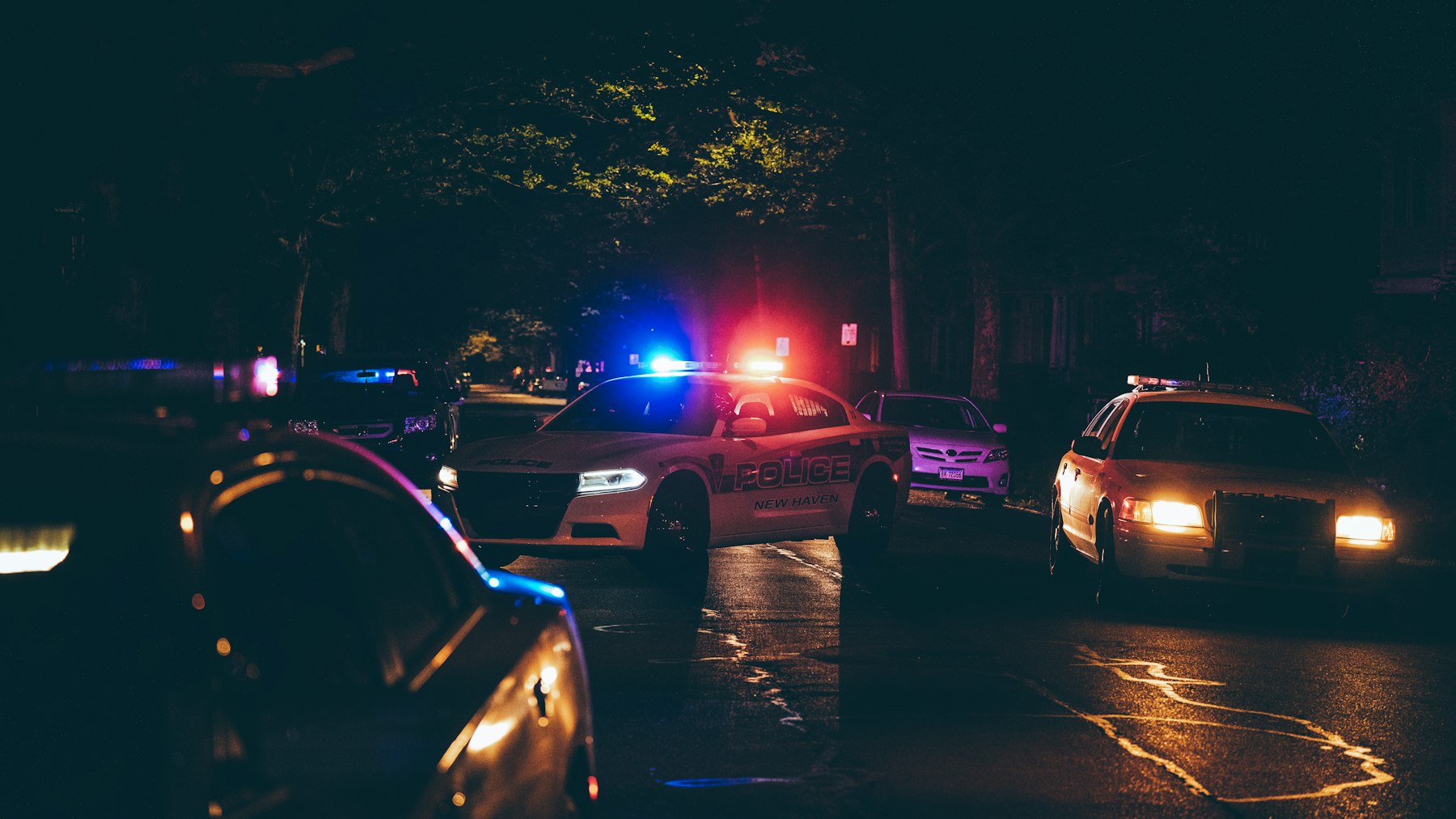
Photo: Police light bar flashing red and blue at night — DWI stop · Unsplash
Before he was a lawyer, Chris Adkins was a Charlotte-Mecklenburg police officer who made DWI arrests and testified about them in court. He has since defended hundreds of people charged with DWI. That experience from both sides of the patrol car shapes the advice in this guide: most DWI cases are decided by small, specific details, and the first ten days after an arrest matter more than most people realize.
What the State has to prove
A person commits the offense of impaired driving if he drives any vehicle upon any highway, any street, or any public vehicular area within this State: (1) While under the influence of an impairing substance; or (2) After having consumed sufficient alcohol that he has, at any relevant time after the driving, an alcohol concentration of 0.08 or more… ; or (3) With any amount of a Schedule I controlled substance… or its metabolites in his blood or urine.
That gives prosecutors more than one path. A driver who blows 0.06 can still be convicted on an appreciable impairment theory based on driving, odor, speech, balance and field tests. A driver who seems fine can be convicted on a 0.08 result alone. Commercial drivers face a 0.04 limit, and drivers under 21 can be charged for any amount of alcohol under G.S. 20-138.3.
The first ten days
You are taken before a magistrate. If your result was 0.08 or more, or you refused, your license is subject to an immediate 30-day civil revocation (G.S. 20-16.5). Conditions of release are set.
Note any DMV hearing deadlines (especially after a refusal), preserve evidence (receipts, witnesses, video locations), and write down everything you remember.
You may be eligible for a pretrial limited driving privilege for the rest of the civil revocation, if you meet the requirements and obtain a substance abuse assessment.
The civil revocation ends after payment of the restoration fee, unless other revocations apply.
Usually several weeks out in Mecklenburg County District Court. It is rarely the trial date.
Refusing a breath or blood test triggers a separate one-year revocation through DMV under the implied consent law, which can be challenged in a DMV hearing that must be requested quickly. It also allows police to seek a search warrant for your blood.
Breath, blood and field sobriety tests
- Standardized field sobriety tests (horizontal gaze nystagmus, walk-and-turn, one-leg stand) must be administered and scored properly to carry weight. Weather, footwear, injuries and the road surface matter.
- Portable breath tests at the roadside generally may be used for probable cause but their numeric result is not admissible at trial.
- The Intox EC/IR II breath instrument at the station requires an observation period, two sequential tests within the allowed tolerance, and a certified operator. Procedural defects can lead to suppression.
- Blood tests require a warrant or valid consent in most cases (Missouri v. McNeely, 2013; Birchfield v. North Dakota, 2016), plus a reliable chain of custody and lab analysis.
For deep dives on each test, see the LKN DWI resource center.
Sentencing levels
If convicted, the judge holds a sentencing hearing and weighs grossly aggravating, aggravating and mitigating factors to choose a level:
| Level | Jail term (may be suspended at lower levels) | Maximum fine |
|---|---|---|
| Aggravated Level One (A1) | 12–36 months | $10,000 |
| Level One | 30 days–24 months | $4,000 |
| Level Two | 7 days–12 months | $2,000 |
| Level Three | 72 hours–6 months | $1,000 |
| Level Four | 48 hours–120 days | $500 |
| Level Five | 24 hours–60 days | $200 |
Grossly aggravating factors include a prior DWI conviction within seven years, driving while license revoked for a prior impaired-driving offense, serious injury caused by the impaired driving, and having a child under 18 (or a person with a disability) in the vehicle.
North Carolina DWI convictions by sentencing level
Fiscal year 2025 (statewide)
Source: NC Sentencing and Policy Advisory Commission
Share of FY2025 DWI convictions at Level 5
23,407 convictions statewide
Source: NC Sentencing and Policy Advisory Commission
Your license after a conviction
A first DWI conviction generally brings a one-year license revocation. Many first-time offenders qualify for a limited driving privilege for work, school, treatment and household needs if they meet the conditions of G.S. 20-179.3. An alcohol concentration of 0.15 or more, or a prior conviction within seven years, can require an ignition interlock device as a condition of restoration. A DWI conviction also brings 12 insurance points under the Safe Driver Incentive Plan, about a 340% premium surcharge.
Defenses that matter
- No reasonable suspicion for the stop, or no probable cause for the arrest.
- Faulty field sobriety testing or medical conditions that explain poor performance.
- Breath-test procedure problems: observation period, operator certification, sequential tolerance.
- Blood-test issues: warrant, consent, chain of custody, lab methodology and the analyst’s availability to testify.
- Rights violations, including the right to have a witness or attorney observe testing within the statutory window, and pretrial release issues.
- Driving and timing: who was driving, and whether the alcohol concentration at a relevant time can be proven.

Boating while impaired on Lake Norman
Lake Norman is patrolled by multiple agencies, and boating while impaired under G.S. 75A-10 uses the same 0.08 standard and impairment theory. Penalties differ from DWI, and a BWI is not a driver’s license offense, but the testing issues are similar. See our boating while impaired page.
Hunter can explain limited driving privileges, sentencing levels or the 30-day revocation. For the full DWI library, his cousin DWI Dave runs the show at lkn-dwi.com.
Is a first DWI a misdemeanor in North Carolina?
Yes. Impaired driving is generally a misdemeanor, but the punishment is set by the DWI sentencing levels. Habitual DWI (three prior convictions within ten years) is a felony.
Can I drive after a DWI arrest in North Carolina?
Usually not for the first 30 days if you blew 0.08 or more or refused. You may qualify for a pretrial limited driving privilege after 10 days.
Will a DWI be dismissed if the officer didn't read my rights?
Miranda warnings matter only for custodial questioning. Implied consent rights and the right to a witness at testing are different, and violations can lead to suppression of evidence. Each case must be analyzed on its facts.
Can a DWI be expunged in North Carolina?
Generally no. North Carolina’s expunction statutes exclude impaired-driving convictions. A DWI charge that was dismissed or ended in a not-guilty verdict can usually be expunged, which is one more reason to fight the charge rather than plead.
How long does a DWI case take in Mecklenburg County?
Many cases take several months to a year, depending on discovery, lab results and the court calendar.
Should I just plead guilty to get it over with?
Not before a lawyer reviews the stop, testing and paperwork. A plea has license, insurance and employment consequences that last for years.
Talk with a Huntersville DWI lawyer
Chris Adkins brings the perspective of a former CMPD officer to DWI defense in Mecklenburg, Iredell and surrounding counties. One-hour consultation, $250, by phone or in person.
Chris Adkins founded Adkins Law, PLLC in Huntersville in 2014. He tries family-law, civil and criminal cases across the Charlotte region, is a certified mediator, a former Charlotte-Mecklenburg police officer and the author of books on North Carolina divorce and DWI law. More about Chris · Attorney Chris Purkey
Sources & further reading
- N.C. Gen. Stat. § 20-138.1, Impaired driving
- N.C. Gen. Stat. § 20-16.2, Implied consent to chemical analysis
- N.C. Gen. Stat. § 20-16.5, Immediate civil license revocation
- N.C. Gen. Stat. § 20-179, Sentencing hearing after conviction for impaired driving
- N.C. Gen. Stat. § 20-179.3, Limited driving privilege
- North Carolina Sentencing and Policy Advisory Commission, DWI statistical report, FY 2025
- Missouri v. McNeely, 569 U.S. 141 (2013); Birchfield v. North Dakota, 579 U.S. 438 (2016)
- LKN DWI Defense resource library
This guide is general information about North Carolina law as of November 2026, not legal advice for your situation. Laws and local rules change, and every case turns on its facts. Reading it does not create an attorney-client relationship. For advice, schedule a consultation with Adkins Law at (704) 274-5677.
More Adkins Law guides

Divorce in North Carolina: the complete guide
One year apart, one claim at a time: how absolute divorce, property, support and custody fit together in Mecklenburg Cou…
Read the guide →
Child custody in North Carolina
Best interest of the child, mandatory custody mediation, parenting plans, relocation and modification, explained for Mec…
Read the guide →
Child support and the 2027 guidelines
How North Carolina's income-shares formula works, what the guidelines effective January 1, 2027 change, and how to modif…
Read the guide →
Alimony and post-separation support
Dependent and supporting spouses, the 16 factors, marital misconduct, how long alimony lasts and why the claim must be f…
Read the guide →
Property division (equitable distribution)
Marital, separate and divisible property, the equal-division presumption, the house, retirement accounts and the three-s…
Read the guide →
Separation agreements in North Carolina
What a separation and property settlement agreement can cover, how to make it enforceable, incorporation, and the mistak…
Read the guide →Share This Story, Choose Your Platform!
Disclaimer: This website provides general information and discussion about legal topics. The content is not legal advice and should not be relied upon as such. Always seek the advice of a licensed attorney for legal matters.