

Who Decides Where a Child Goes to School in North Carolina? School Choice, Joint Legal Custody, and Child Custody Disputes

School starts in a few weeks. One parent has already bought the backpack. The other parent has already toured a different school. Someone has filled out an enrollment form. Someone else has sent an email saying, “You cannot do that without my permission.”
And suddenly, a disagreement that began with school calendars, bus routes, or test scores has become a North Carolina child custody dispute.
For separated and divorced parents, the question “Where should our child go to school?” is rarely just an educational question. It can involve legal custody, physical custody, school-district residency rules, transportation, private-school tuition, charter-school lotteries, homeschooling, and ultimately the best interests of the child.
The first place to look is usually not Google Maps, the school website, or even which parent has the child more nights.
It is the custody order.
North Carolina’s Judicial Branch describes legal custody as the right to make major decisions concerning a child, while physical custody concerns the right to have the child physically in a parent’s care. The Judicial Branch specifically identifies where a child attends school as the type of major decision parents with joint legal custody ordinarily must make together. If the parents cannot agree, a court may ultimately have to decide the issue.
That distinction sounds simple. In real family-law cases, it can become anything but simple.

School Choice Is Usually a Legal-Custody Question
North Carolina law directs a court entering a custody order to fashion an arrangement that will best promote the interest and welfare of the child. The court must consider all relevant factors, make findings supporting its best-interest determination, and may award joint custody, exclusive custody, or other appropriate terms. There is no automatic presumption between a child’s parents that one is the preferable custodian.
That framework matters because parents sometimes confuse parenting time with decision-making authority.
Suppose Mom has the children from Sunday evening until Friday afternoon during the school year. Dad has alternating weekends, holidays, substantial summer time, and joint legal custody. Mom may understandably think, “The children live with me during the school week, so I choose the school.”
Not necessarily.
Primary physical custody answers an important question: where does the child principally live? It does not automatically answer another question: who has the legal authority to make a major educational decision?
If the order says that the parents share joint legal custody with no special allocation of educational decisions, school selection normally calls for consultation and joint decision-making. The North Carolina Judicial Branch expressly uses school attendance as an example of a major decision parents with joint legal custody make jointly.
The reverse can also be true. A parent could have less parenting time but possess specific decision-making authority under the terms of the custody order.
The point is that “primary custody” is not a magic phrase that settles every dispute. Family law would be considerably easier if two words solved everything, but lawyers would probably have less to do.
“Joint Legal Custody” Does Not Always Mean a Permanent 50/50 Veto
There is another important qualification.
Parents sometimes hear “joint legal custody” and assume that neither parent can ever make a major decision unless both parents enthusiastically agree. That is a reasonable starting point, but North Carolina appellate law demonstrates that courts can structure joint legal custody more carefully.
In Hall v. Hall, a published 2008 decision, the North Carolina Court of Appeals specifically addressed an award of joint legal custody coupled with a division of decision-making responsibilities.
A decade later, in Eddington v. Lamb, another published Court of Appeals decision, the appellate court again dealt with joint legal custody accompanied by divided decision-making authority.
And in Ward v. Halprin, the issue reached the North Carolina Supreme Court in a case concerning an award of final decision-making authority to one parent.
Those cases are important because they show why a lawyer should not stop reading a custody order immediately after finding the words “joint legal custody.” The next paragraph may matter more.
An order can provide, for example, that the parents consult each other but that one parent has final authority over education if they reach a genuine impasse. Another order might divide responsibilities so one parent has greater authority concerning education while another has authority in a different area. Still another might require true joint agreement.
For a parent facing a school dispute in Huntersville, Lake Norman, Mecklenburg County, or elsewhere in North Carolina, the precise language of the existing custody order is often more important than the label placed on the custody arrangement.
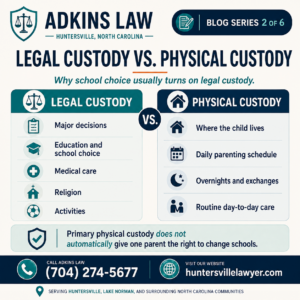
Legal Custody and Physical Custody Are Different Jobs
Think of legal and physical custody as answering different questions.
Physical custody asks: Where is the child sleeping tonight? Who is getting the child to soccer practice? Who is making dinner? Who is handling the normal Tuesday-night crisis involving a missing Chromebook charger?
Legal custody asks: Who has authority to make significant decisions about the child’s life?
Those major decisions can include education, major medical care and other significant issues affecting the child. North Carolina’s official custody guidance expressly distinguishes these two concepts.
That distinction becomes especially important when parents live in different school zones.
Imagine a child has lived primarily with one parent for three years and attends the neighborhood public school. The other parent then moves to a different area with a school the parent believes is academically stronger. The second parent may have a good argument about educational quality. But merely having a new address does not automatically create authority to change the child’s school.
Likewise, the parent with the address currently used for school enrollment does not automatically acquire exclusive educational decision-making authority merely because the school system recognizes that residence for enrollment purposes.
There are really two different legal layers operating at the same time.
The family-law layer asks which parent has authority to make the educational decision.
The education-law layer asks whether the child is eligible to attend the particular public school in the first place.
Confusing those two layers can create a mess remarkably quickly.
A Custody Judge Does Not Run the School District—and the School Registrar Does Not Rewrite Your Custody Order
North Carolina law generally provides that students domiciled within a local school administrative unit are entitled to attend the public schools to which they are assigned by the local board of education. The statute governing student assignment gives the local education system an independent role in deciding school assignment and eligibility.
So even if two parents agree that School A would be wonderful, the family cannot simply assume that the child qualifies for School A.
Conversely, simply because a school system would permit enrollment using one parent’s address does not necessarily mean that parent had the authority, as between the parents, to make the decision unilaterally.
That is why a parent facing a school-choice dispute should begin by answering two separate questions:
What does our custody order authorize? And what do the school’s actual enrollment and residency rules permit?
The answers need to work together.
The Address Problem
School-address disputes can become particularly unpleasant.
Sometimes a parent continues using an old address after moving. Sometimes one parent’s address is used because it produces a preferred school assignment. Sometimes a grandparent’s home gets pulled into the discussion. Sometimes both parents genuinely believe different residency rules apply.
Whatever the explanation, relying on inaccurate or unverified residency information is a bad foundation for a custody position.
Even apart from whatever the school system ultimately does with enrollment, walking into family court after knowingly creating an address problem can distract from what should have been the stronger argument: why a particular educational arrangement actually benefits the child.
Judges generally have more useful things to evaluate than a parental version of “technically, the mail still goes there.”
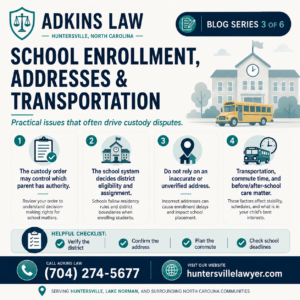
Transportation Can Turn a “Better School” Into a Worse Plan
School-choice litigation is often won or lost in the details.
A parent may arrive at court armed with rankings, test scores and a beautifully designed school brochure. The other parent may arrive with a calendar showing that the proposed school creates a 55-minute drive each morning, eliminates the child’s after-school arrangement, conflicts with both parents’ work schedules, and puts the child in the car for an additional eight hours each week.
The second set of evidence may matter a great deal.
North Carolina’s custody statute tells judges to focus on the child’s interests and welfare and to consider all relevant factors. It does not contain a rigid statutory checklist saying that the school with the highest test score wins.
In an actual school-choice dispute, relevant evidence therefore may include continuity in the child’s present school, academic performance, special-education or therapeutic resources, transportation time, before- and after-school care, the child’s social and extracurricular connections, each parent’s work schedule, the reliability of transportation plans, and the practical ability of both parents to support the proposed arrangement.
Those are not statutory boxes that a judge is required to check one by one. They are examples of facts that can help answer the broader statutory question: what arrangement best promotes this particular child’s welfare?
The strongest custody presentation usually does not sound like:
“School A is better because I say it is.”
It sounds more like:
“Here is the child’s history. Here are the available schools. Here is the transportation plan. Here are the services each school offers. Here is the child’s current academic situation. Here is how each proposal works during both parents’ custodial time. And here is why our proposal better serves this child’s actual needs.”
That is a much different argument.
Magnet Schools, Charter Schools and Private Schools Add Another Layer
School choice becomes even more complicated when the disputed school is not simply the neighborhood public school.
A magnet application may have a deadline months before the coming school year. A charter-school seat may depend on a lottery. A private school may require deposits, contracts, tuition and a commitment before a custody hearing can realistically be scheduled.
The calendar has no particular sympathy for family law litigation.

Magnet Schools: Do Not Turn an Application Into a Surprise Announcement
A parent may believe there is no harm in simply applying to a magnet program: “It is only an application. We can decide later.”
Sometimes that is sensible. In a high-conflict joint-custody case, however, even an application can become evidence of how the parents communicate—or do not communicate—about important decisions.
The better practice is usually transparency.
If a deadline is approaching, communicate in writing. Identify the program, the deadline, the reasons for considering it, transportation implications and whether applying creates any immediate obligation. If the parents ultimately disagree, there will at least be a record showing that one parent attempted to address the issue in advance rather than presenting the other parent with a fait accompli.
Courts tend to have plenty of genuine mysteries. There is no particular benefit to making “Why did you enroll the child without telling the other parent?” one of them.
Charter Schools: Winning a Custody Argument Does Not Win the Lottery
North Carolina charter schools present an especially interesting wrinkle because admission is governed by state law rather than ordinary neighborhood assignment.
Under current North Carolina law, an eligible student who timely applies to a charter school generally must be admitted unless applications exceed the available capacity. When applications exceed capacity, students are accepted by lottery, subject to statutory priorities and permitted preferences.
That means a custody plan built around a charter school sometimes needs a Plan B.
A parent can prevail in an argument that a particular charter school is the preferable educational choice and still confront the inconvenient reality that the child did not receive a seat.
Good custody orders and agreements anticipate reality. They can address not merely the preferred school, but what happens if admission is denied, the child is wait-listed, transportation changes, or the program ceases to be available.
Family law works much better when the order answers tomorrow’s foreseeable question instead of guaranteeing another court hearing when tomorrow arrives.
Private School: “Who Chooses?” and “Who Pays?” Are Two Different Questions
Private-school cases frequently combine two disputes that should be separated analytically.
The first is educational decision-making: may the child attend the private school?
The second is financial responsibility: who pays the tuition?
Winning the first question does not automatically resolve the second.
North Carolina’s currently posted Child Support Guidelines recognize certain expenses for special or private elementary or secondary schools as potential extraordinary child-related expenses. Those expenses may be added to the basic child-support obligation and allocated between the parents when the court determines that they are reasonable, necessary, and in the child’s best interest.
That language is significant. It does not say that every parent who prefers private school may send the other parent half the tuition bill.
A private-school dispute may require evidence concerning why the school is appropriate for the particular child, whether the child has historically attended private school, any particular educational needs, the financial circumstances involved, the terms of an existing child-support order or separation agreement, and what the parents previously agreed to do.
In other words, a custody order is not automatically accompanied by a scholarship.
This is also an area where divorce planning matters. North Carolina allows parents to address custody and support in a separation agreement, although courts retain authority over child custody based on the child’s best interests.
Thoughtful drafting during a separation or divorce can therefore prevent a surprising number of future disputes over tuition, extracurricular expenses and educational choices.
Homeschooling Is a Major Decision, Not Just a Change of Classroom
Homeschooling cases can become especially contentious because the proposed change affects far more than the name above the schoolhouse door.
It can alter the child’s daily schedule, social environment, instructional structure, transportation, interaction with each parent and potentially the amount of responsibility one parent assumes for education.
North Carolina law defines a home school as a form of nonpublic school in which the parents, legal guardians, or members of the relevant households determine the scope and sequence of instruction, provide instruction and determine additional instructional sources. North Carolina also imposes statutory qualifications and requirements, including annual testing requirements and a requirement that the person providing academic instruction hold at least a high-school diploma or equivalent.
But there is an important family-law distinction:
Being legally capable of operating a homeschool does not necessarily mean one parent has the custody authority to unilaterally remove a jointly parented child from the child’s existing school and begin homeschooling.
The homeschool statutes answer whether the educational arrangement satisfies North Carolina’s homeschooling law. The custody order answers a different question: who gets to decide that this child will be homeschooled?
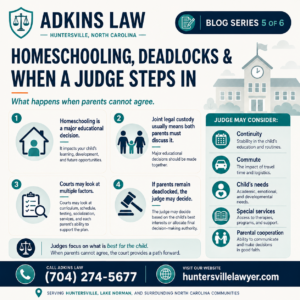
What Might a Judge Want to Know About a Homeschool Proposal?
There is no single North Carolina statute declaring that courts must compare homeschooling and traditional schooling according to a fixed checklist.
Instead, the broader best-interest standard applies.
That means the quality of the evidence matters.
A parent proposing homeschooling might be prepared to explain the curriculum, instructional schedule, testing plan, who will provide instruction, how the plan works during the other parent’s custodial time, how special educational or therapeutic needs will be met, what social and extracurricular opportunities are available, and why the change would improve the child’s situation.
The other parent may offer evidence about the child’s success in the current school, established friendships, special services, academic progress, concerns regarding supervision, the parents’ schedules, or the practical problems created by the proposed plan.
“I think homeschooling is better” and “I think public school is better” are opinions.
A custody trial needs evidence.
What Happens When Parents Simply Cannot Agree?
This is where school-choice cases stop being theoretical.
Two reasonable parents can genuinely reach different conclusions about the same child.
One values continuity. The other believes the child needs a stronger academic program.
One thinks the hour-long commute is unreasonable. The other believes the educational opportunity justifies it.
One wants a small private school. The other wants the neighborhood public school.
One wants homeschooling. The other thinks the child desperately needs the structure and social environment of a traditional classroom.
Joint legal custody does not require parents to develop identical personalities or identical parenting philosophies. It does, however, require parents to operate within the terms of their order.
North Carolina’s Judicial Branch states directly that when parents with joint legal custody cannot agree on a major decision such as school attendance, a court may have to make the decision.
Sometimes the solution is a ruling about the immediate school.
Sometimes the larger problem is that the existing decision-making structure no longer functions.
A Recent North Carolina Supreme Court Story: When Conflict Becomes Part of the Custody Problem
A particularly useful modern example comes from Durbin v. Durbin, decided by the North Carolina Supreme Court in August 2025.
The case did not involve a simple disagreement about which school had the nicer science lab. It involved something broader and more important: parents whose conflict had escalated to the point that their ability to make decisions affecting their children had deteriorated.
According to the Supreme Court’s official case digest, the trial court found increasing conflict, hostility toward a parenting coordinator, and an unwillingness to communicate or cooperate concerning the children’s medical care. The findings included a failure to take the children to weekly therapy and a failure to administer prescribed asthma medication. The Supreme Court upheld a modification that moved the arrangement from joint custody to primary physical custody with the mother and gave her final decision-making authority over major parenting decisions.
The lesson extends well beyond medical care.
Courts are not interested merely in awarding a trophy for “Parent Who Was More Correct During the Argument.” They are concerned with how the conflict affects the children.
If parents repeatedly deadlock over school, medical treatment, therapy and other fundamental decisions—and that inability to function together begins affecting the child’s welfare—the decision-making structure itself can become part of the custody issue.
That is why communication matters even when the other parent is difficult.
A calm email offering two schools, explaining the advantages and disadvantages, and proposing a deadline for discussion looks very different in an exhibit notebook than 37 text messages ending with, “SEE YOU IN COURT.”
Both may convey the same general sentiment. Only one is likely to help.
North Carolina Appellate Courts Continue to See Final-Authority and Unilateral-Decision Cases
This is not an outdated problem.
Just two days before this article was prepared, the North Carolina Court of Appeals issued Idilbi v. Hauser on August 5, 2026. The case is unpublished, so it should not be treated here as the controlling authority for a legal proposition, but its official case summary is revealing: the issues included joint legal and physical custody, modification, final decision-making authority, unilateral decisions, and the children’s best interests.
In other words, families are still litigating precisely these questions.
The words “joint legal custody” do not make human disagreement disappear.
When Does a School Dispute Become a Custody-Modification Case?
There is an important difference between asking a court to enforce an existing order and asking the court to change a permanent custody order.
Suppose the order expressly gives Mother final educational decision-making authority after consultation, and Father nevertheless changes the child’s enrollment contrary to the order. That may present an enforcement issue. North Carolina’s Judicial Branch explains that a parent may seek an order to show cause or contempt when the other parent violates a custody order.
Now change the facts.
Suppose the order requires joint decisions. The parents were able to cooperate when the order was entered three years ago, but their relationship has deteriorated so badly that every medical, educational and extracurricular decision produces another impasse. One parent asks the court to modify the custody arrangement and award final decision-making authority.
That is a modification case.
North Carolina law permits modification of a custody order upon the required showing of changed circumstances, and the Judicial Branch explains the operative standard for a permanent order: the moving parent must establish a substantial change in circumstances affecting the child such that a change is necessary to serve the child’s best interests.
The North Carolina Supreme Court’s decision in Shipman v. Shipman remains a leading published custody-modification case, and more recent cases such as Durbin apply the substantial-change framework in modern high-conflict parenting disputes.
The practical distinction matters enormously.
A parent should not automatically ask the court to overhaul an entire custody arrangement simply because the parents disagree about one school. Likewise, a chronic pattern showing that the current joint-decision model has become unworkable should not necessarily be treated as though the only issue is whether School A beats School B.
The requested remedy should match the actual problem.
The Best-Interests Standard Is About the Child, Not About Winning the Argument
North Carolina’s statutory standard repeatedly brings the analysis back to one idea: the interest and welfare of the child.
The North Carolina Judicial Branch describes the custody analysis similarly, explaining that judges may consider the parents’ living arrangements, their ability to care for the child, the child’s relationship with the parents, and other circumstances affecting the child’s welfare. Fairness to the parents matters, but it is secondary to the child’s welfare.
That is enormously important in school cases.
A judge is not deciding which parent has the better taste in schools.
The court may effectively be asking:
Will this child have stability?
How will the child get there every morning?
Will the schedule work in both homes?
Is the child currently thriving or struggling?
Does the proposed program address a genuine educational need?
What services does the child require?
What happens if the preferred school has no seat?
Can these parents actually implement the plan?
Will the decision reduce disruption or create more of it?
And perhaps most importantly: Which proposal is supported by actual evidence rather than parental frustration?
A school dispute frequently becomes much easier to analyze when the parents stop asking, “Which parent should win?” and begin asking, “What will this look like for the child at 6:45 on a rainy Tuesday morning in February?”
Reality is often excellent evidence.
What Parents Should Do Before a School Dispute Reaches Court
The most useful first step is deceptively simple: read the entire custody order.
Not just the caption. Not just the paragraph containing the parenting schedule. Not just the words “joint legal custody.”
Read every provision addressing education, major decisions, consultation, notice, dispute resolution, final authority, transportation, school districts and access to records. North Carolina law also generally gives each parent equal access to a child’s health, education and welfare records unless a court order provides otherwise.
Then gather the evidence that turns the proposed school from an opinion into a plan: actual enrollment requirements, reliable residency information, transportation times, application deadlines, tuition information if applicable, the child’s records, available services, communications between the parents and a workable backup plan.
The goal should not be to manufacture litigation.
Quite the opposite.
A good North Carolina family law attorney may be able to identify that the order already answers the question, help the parents negotiate a solution, draft a narrow agreement addressing education, or determine whether judicial intervention is actually necessary.
And when court is necessary, early preparation matters. School calendars are not designed around district-court calendars. Waiting until the Thursday before classes begin to reveal a six-month disagreement rarely improves anyone’s options.
School Disputes During Separation and Divorce
Parents do not have to wait until an absolute divorce to address custody.
North Carolina’s Judicial Branch confirms that child-custody claims are not extinguished or controlled by the timing of an absolute divorce; parents may pursue custody regardless of whether they are married, separated, divorced or were never married.
That makes educational decision-making something worth considering while a custody agreement or consent order is being drafted, not merely after the first disagreement occurs.
A well-drafted agreement can address what “joint legal custody” actually means for that family. It can establish consultation procedures. It can allocate decision-making authority. It can provide a mechanism for genuine deadlocks. It can address transportation. It can anticipate private-school tuition or extracurricular commitments. It can identify what happens if an anticipated school placement becomes unavailable.
A few careful paragraphs today can sometimes prevent several thousand dollars’ worth of litigation next year.
That may not be the most romantic feature of a separation agreement, but neither is property division.
The Bottom Line: Who Decides Where a Child Goes to School in North Carolina?
The answer depends on the custody arrangement.
If one parent has sole legal custody, that parent ordinarily has broader authority to make major educational decisions, subject to the actual language of the order.
If the parents have joint legal custody, North Carolina’s general framework contemplates consultation and joint decision-making over major issues such as school choice. But the order may allocate authority differently or give one parent final decision-making power in a particular area. Published appellate decisions such as Hall v. Hall and Eddington v. Lamb, along with the Supreme Court’s consideration of final decision-making authority in Ward v. Halprin, illustrate why the exact wording matters.
If there is no custody order, the North Carolina Judicial Branch states that both legal parents generally have equal rights concerning the child.
If the parents remain deadlocked, a judge may ultimately have to resolve the issue based on the child’s best interests. And if the disagreement is part of a larger breakdown in an existing permanent custody arrangement, the matter may potentially involve enforcement, modification, or an allocation of final decision-making authority.
Meanwhile, even after the family-law issue is resolved, the particular school still has to be legally available to the child under the applicable enrollment, residency, admissions or lottery rules.
So the real answer is not simply “Mom decides,” “Dad decides,” or “the primary parent decides.”
It is:
Read the custody order. Determine the parents’ legal authority. Confirm the school’s enrollment rules. Then focus the evidence on what actually serves the child.
That is where the analysis should begin.

Questions About School Choice or Child Custody in North Carolina?
School disputes can arise during a separation, in an existing child custody case, years after a divorce, or when a parent’s circumstances change. They may involve joint legal custody, school enrollment, relocation, homeschooling, magnet or charter schools, private-school tuition, modification of custody, enforcement of an existing order, or a request for final decision-making authority.
Adkins Law, PLLC represents clients in North Carolina family law matters involving child custody, divorce, separation, custody modification and enforcement, and other domestic disputes.
For families in Huntersville, Lake Norman, and surrounding North Carolina communities, Adkins Law can review the custody order, evaluate the educational dispute and help determine what options are available before a school disagreement turns into an unnecessary crisis.
Call Adkins Law at (704) 274-5677 or visit huntersvillelawyer.com.
This article is provided for general educational information concerning North Carolina family law and is not legal advice for any particular case. Custody decisions are fact-specific, and the language of an existing order can materially change the analysis.
Share This Story, Choose Your Platform!
Disclaimer: This website provides general information and discussion about legal topics. The content is not legal advice and should not be relied upon as such. Always seek the advice of a licensed attorney for legal matters.